
A Candidate, A Columnist, and A Change-Maker Confuse A Bunch of Karens Who Miss the Point. As Usual.

The pawnification1 of two thought leaders I admire by a bunch of Karens was not on my bingo card this month but here we are. Though you wouldn’t know it from our executive branch of government (or legislative or judicial), I like to think that at least some of us still exist in a world where two people with similar racial and gender identities can hold different opinions because, despite said similarities, they may have a host of other differences that could result in - WAIT FOR IT - a different set of opinions.
It started with an OpEd. Tressie McMillan Cottom - public sociologist extraordinaire/NYT columnist/byline sharer (for a brief but joyous period) with yours truly - weighed in on happenings here in Maine and it wasn’t good.2
By now, you may have heard about Graham Platner, the U.S. marine turned oyster farmer turned harbormaster turned Democratic hopeful looking to unseat Republican Senator Susan Collins in next year’s election. As Cottom rightfully suggests, “Platner could be the Democratic Party’s new great white hope — a working-class white man who can speak to class antagonism in an economically unequal electorate.”
If only those pesky racist, sexist, homophobic online posts from the past hadn’t been unearthed. Oh, and then there’s the matter of that Nazi tattoo. Platner has been working overtime to explain these lapses in sanity.
If you ask me (and nobody did but here we are) Platner’s explanation is sincere. I believe him when he says that he abhors the words and statements he made at an earlier stage of his life. I believe him when he says he that he made these remarks during a period of his life marked by PTSD and depression, having served deployments in Iraq and Afghanistan, and working to extricate himself from the “male-dominated, masculine world” of the infantry, characterized by “crude humor,” “dark feelings,” and “offensive language” that were “hallmark[s] of the infantry” when Platner was in it.
I believe that Platner made these remarks. I believe that Platner regrets making these remarks. I believe that Platner has since done the work needed to understand why and how his remarks were and are offensive, threatening, violent, unquestionably wrong, and disgusting. I do not believe that these remarks reflect Platner’s feelings today.
I was inclined not to forget but to move forward with Platner and then Democratic heavyweights Bernie Sanders and Chris Murphy had to go and weigh in, chiding us to forgive Platner. To quote the one and only Truly Brown of Sister Wives (who knows a thing or two about how to decline politely when obtuse yet powerful men try to get you to do something you don’t want to do), “No thank you, daddy.” The last thing I need is some daddy big wig senator from some other state trying to tell me what to do or how to feel.
Now, is that what Sanders or Murphy intended to do? I’ll give them the benefit of the doubt and go with probably not. And here’s where Cottom shines. She is a sociologist, afterall. We excel at identifying the unintended consequences that policy makers (and, sometimes, friends, acquaintances, and fellow party attendees3) would prefer we pretend not to notice. As Cottom rightly notes,
“These senators are demonstrating a willful blindness that has become endemic in the Democratic Party. Their rhetoric - and the conventional wisdom that flows from it - suggests that we cannot talk about economic solutions without abandoning our commitment to the Black, Latino, gay, transgender and female poor that are the lifeblood of the Democratic party’s base. The conceit at the heart of that belief is that poor white people are too racist, and too uniquely ignorant of their racism, to vote in their best interests. Therefore, Democrats have to accept a little racism to win the working class.”
Are Democrats really willing to sell their souls, as Republicans have done with Trump, for the win? Are they really prepared, as Cottom suggests, to accept racism, to abandon their gay and lesbian brothers and sisters, to leave women in the dust, even if just a little? Who are we kidding? I’m not saying it’s a winning approach for Dems but it is an approach.4 I guess.
If ever there was a worse argument for ignoring Platner’s remarks than Bernie Sanders’ there are “more important issues,” I haven’t seen it. And do Platner’s own explanations make his words ok? Of course not. But they do contextualize those words. For while we sociologists are all about patterns, we’re also sticklers for context. That is crucial here. Because Maine is, dare I say it, unique.
A couple days later, still chewing over Cottom’s take on Platner, my phone alerted me that Black Girl in Maine, a.k.a. Shay Stewart-Bouley, had something to say about Cottom on Threads. My worlds were colliding - an admired national commentator had taken notice of an admired local change-maker! Alas, it wasn’t great.
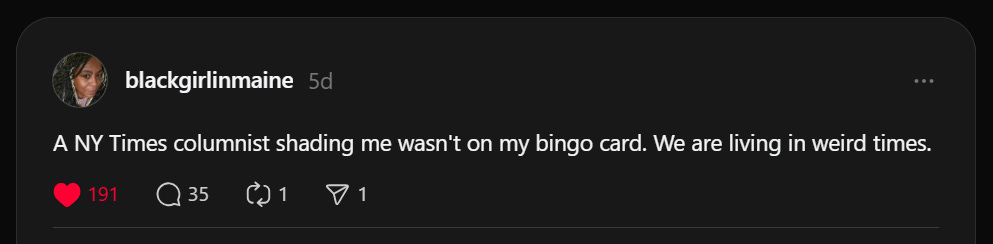
Stewart-Bouley was responding to a video Cottom had posted on her Instagram page, describing the hundreds of messages she’d received from readers of a “similar demographic” (read: white) in response to her column on Platner. Apparently, said readers felt the need to inform Cottom that there was a human elsewhere in the country who, despite chromosomal and melanineal similarities, had - GASP - a different opinion from her!

What can I say? Karens gonna Karen. As an upper middle class white lady of a certain age, I know this. It’s a force I myself must be on constant alert for; not as a potential victim but as someone who meets many of the qualifications as a potential perp. And may I just say to the hundreds of Karens who felt the need to let Cottom know that there was a Black woman somewhere in the country with an opinion different from her own, would please, kindly…
Pull up a chair. Take a seat. Stop talking. Have a listen.
What you did with Cottom? That’s racist. As she notes, the messages coming from these folks “...had absolutely nothing to do with me. It was not being done at my direction or at my behest. It was being done with me as a tool, not with me as a collaborator or a person.”
Now, I’m not going to get into the weeds on whether Cottom actually did shade Stewart-Bouley because my point here, as I’ve said, is that Karens gonna fricken’ Karen. It is apparently beyond comprehension for a Karen that two humans with some crossover in demographics (namely, race and gender) might have a difference of opinion about someone whose demographics differ from their own.
It is in a related take-away about Platner where Cottom loses me. As sociologists, we’re great at recognizing patterns - and she’s not wrong when she notes that “the working class in this country looks more like a Latino woman who cleans houses than it looks like Platner” (emphasis my own). But not in Maine.
While not exactly a bragging point, Maine happens to be the whitest state in the nation therefore Platner does resemble the working class here in that regard. As a Maine-born veteran and oyster farmer, he actually stands a chance in Maine’s second congressional district, characterized by a suspicion of outsiders and the sort of rugged libertarian individualism that can result from years of weathering protracted winters deep in Stephen King country.
Now, we’ve been fooled by these types before. Exhibit A:
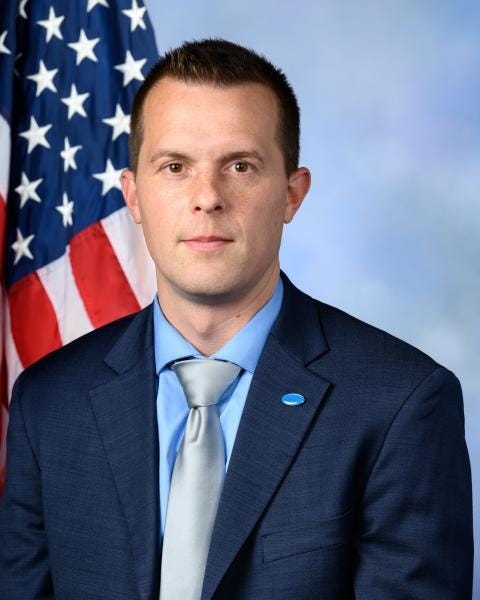
Fool me once and all (or twice if you are a Golden boy). But, for now, I’m taking a chance on Platner - largely because, as Stewart-Bouley notes, “we are in a battle for the survival of our country, and we need people who are willing to call shit out and do the hard work, even if they are rough around the edges.” She goes on to note that only time will tell whether Platner is the real deal. Indeed.
Platner himself wants us to know that he made his offensive remarks at a time when he was “...struggling … having a very hard time settling back into a society that he felt betrayed by and left behind by, after having to fight in Iraq and Afghanistan.” He goes on to say, “I’m sorry for this. Just know that it’s not reflective at all of who I am. I don’t want you to judge me on the dumbest thing I ever wrote on the internet. I would prefer if people could judge me on the person I am today.”
I am willing to do that, Graham. I am listening. And I’ll be watching. In the meantime, can the Karens out there please pipe down?
pawn⬝i⬝fi⬝ca⬝tion
noun
the use or manipulation of another person’s purposes.
“the 45th/47th president of the United States is a master at pawnification”
the pawnifying of people.
“Karens - including well-intentioned progressives - are sometimes guilty of engaging in pawnification when complex arguments challenge deeply embedded racist beliefs they may not even be aware of but have been taught and held for many years.”
I reached out to Tressie McMillan Cottom and Shay Stewart-Bouley on the afternoon of Friday, November 7 and invited them to provide response/comments on this piece by 10am EST on Monday, November 10. I have not received a reply from Cottom. I did hear back from Stewart-Bouley who shared that she recently met with Platner for the second time and would be sharing her written thoughts soon. Please follow, share, and support her work: Substack, website, Threads.
While I like to think of myself as the life of the party and up for a good time with just about anyone, push my buttons and the sociological killjoy in me isn’t too far beneath the surface. Ask that guy who told me at a party one time that if I really wanted to make a difference, I’d be having kids of my own and I was wasting my time mentoring people in their teens and 20’s because they are too far gone by that age.
See, for example, Democratic Party presidential primaries 2024, 2020, and 2016.
Thank you for your perspective as a Mainer and a sociologist!❤️