
Aftershock
Long COVID and the Disappearing Millions

I recently returned home from a few days in San Diego with my favorite feminist sociologists. My favorite feminist sociologists and my favorite feminist sociologist in training, my boo, my forever, my partner-in-crime, my “where the hell is her wheelchair?!” asker, my I’ll-push-your-wheelchair-through-the-airport-when-noone-shows-up (AGAIN) wheelchair pusher, my favorite human, Lance.
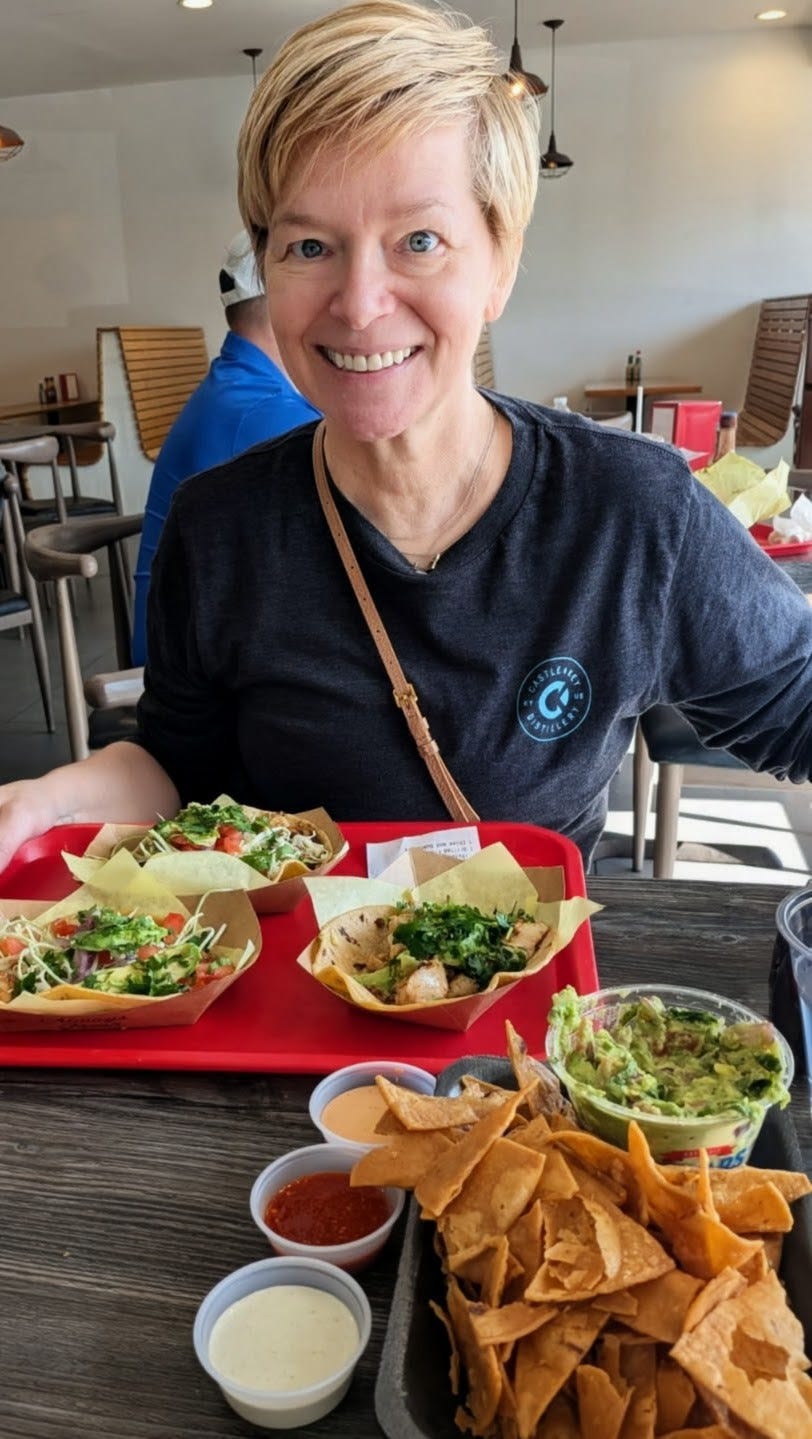
I’m excited to share some observations from the conference itself in a future post but, for today, I thought I’d share one of the two presentations I gave while there. This one comes from a work-in-progress, tentatively titled AFTERSHOCK: LONG COVID AND THE DISAPPEARING MILLIONS. But first, a taco break…
AFTERSHOCK: LONG COVID AND THE DISAPPEARING MILLIONS
Presented by Dr. Amy Blackstone
Sociologists for Women in Society Winter Meeting
San Diego, CA
My presentation today is based on a collaboration with my partner Lance. AFTERSHOCK: LONG COVID AND THE DISAPPEARING MILLIONS traces the silent yet deadly advance of Long COVID through bodies around the world following the COVID-19 pandemic. Interlaced throughout that story is the tale of my own fight to solve the riddle of my symptoms after contracting the virus at the very start of the pandemic.
Recently, after sharing an article on social media about the increasing numbers of Long COVID patients going without care thanks to clinic closures across the country, my dear friend and respected medical sociologist Dr. Karen Lutfey Spencer made the following observation:
“This cohort of people dealing with under-managed disability is going to become everyone’s problem even though people think it can’t happen to them or it’s fabricated.”
Dr. Spencer is absolutely right. Though I’d argue that it’s too late. We already ARE your problem. Some of you just don’t feel it. YET. If you remember nothing else that I share with you today, I hope that you remember this.
I certainly didn’t think the “flu” I’d heard about making its way over to us from China was much of a threat when I stepped onto the plane that would change my fate that afternoon on March 11, 2020. And yet, a year later, this would be my journal entry:
Fog creeps in, seeps in slowly. It’s a tricky fucker. Slipping into the tiniest of crevices, spaces you didn’t know were there. Your mind slows to a crawl. Words slip away, just out of reach. Mental tasks that were so easy before are impossible now. Your thoughts are trapped in a dense, damp mess that you can’t see through or push away. Slowly you begin to live with it. Live in it.
You’re unable to pinpoint the exact moment the fog took over – you’re the frog on slow boil – but eventually you can’t deny that it has. You realize this is it. The clarity you once had is gone. This is life with Long COVID. No more Life 1.0…Life 2.0 has begun. Life-adjacent. Life-like. Life-ish. Life sorta kinda.
I’m reminded of a song I had on repeat during my teen years; Depeche Mode’s “Master and Servant.” The lyric goes, “You treat me like a dog, get me down on my knees.” I’m the dog, down on my knees. I’m the servant and the fog is my master. On rare days I’m allowed out. But always, the servant heeds its master. Afterall, “Domination’s the name of the game.” Playtime always ends, and when it does, it’s back to the fog and the certainty that this is my life now.
Trapped in an emerging pandemic with a buffoon at the helm, the virus entered bodies, settled in, and decided to stay. Unwilling hosts to an unwelcome guest. Much like the aftershock that follows an earthquake, Long COVID appeared as we were distracted by the first blow dealt by the spread of the virus. The second hit, the aftershock, may not provide the tabloid-worthy photo ops of bodies spilling out from over-full morgues but it is deadly nonetheless, leaving millions buried alive, screaming for help, going unheard.
And yet, let me remind you, as my friend Dr. Karen Lutfey Spencer so wisely noted:
“This cohort of people dealing with under-managed disability is going to become everyone’s problem even though people think it can’t happen to them or it’s fabricated.”
And, yet again, I will argue: It’s too late. We already ARE your problem. Some of you just don’t feel it. Yet.
Not convinced? Let me share some facts compiled by the Patient Led Research Collaborative, an organization I’m involved in that connects patients to clinical trials and research studies.
WE - LONG COVID PATIENTS - ARE UBIQUITOUS
Long COVID is common. As of fall 2024, at least 1 in 19 US adults are living with Long COVID - similar to the rate of diabetes - with many additional cases likely going undiagnosed or misdiagnosed.
Recovery from Long COVID is rare. Only 6-9% of people with Long COVID are recovered at 2-3 years.
WE RELY ON STRONG SAFETY NETS AND SOCIAL INSTITUTIONS
At 2 years, only 40% of Long COVID patients could work full-time.
People with Long COVID are nearly twice as likely to report housing insecurity.
People with Long COVID report high rates of food insecurity and difficulty paying utility bills.
THE ECONOMIC COST OF LONG COVID IS TOO HIGH TO IGNORE
Five years of Long COVID burden is projected to cost $3.7 trillion to the US economy in reduced quality of life, lost earnings, and increased medical spending.
In 2024, 1.5 billion work hours were lost in the US due to Long COVID corresponding to a potential cost of more than US $152.6 billion.
The global economic cost of Long COVID is estimated at $1 trillion per year.
THE VIRUS SPREADS MORE EASILY THAN KNOWLEDGE ABOUT IT
Researchers know a lot but that knowledge has not spread beyond the ivory towers and bureaucracies where it is generated. The public and providers/practitioners claim to know very little about the condition.
As of LC Awareness Day in 2025 (March 15), over 86,000 research papers had demonstrated wide-ranging biological abnormalities in Long COVID (PLRC Fact Sheet).
Yet, by that same time, over ⅓ of people had still not heard of Long COVID despite its wide impact (PLRC Fact Sheet).
And, only 7% of physicians say they are very confident diagnosing Long COVID and only 4% are very confident treating it (PLRC Fact Sheet).
What can we do about all this?
Trust patients. Believe patients. Listen to patients.
Protect yourself and others by wearing a mask - don’t spread the virus.
Check in on your people with chronic illnesses. Many are isolated, too often forgotten.
Help spread the word! Use the term Long COVID, help people understand it EXISTS, it is REAL, and they can and should protect themselves from it.
Advocate for differently abled people in public spaces - work, third spaces, community, etc. - as more people are disabled, more people will need accommodations or more brains and bodies will simply go to waste.
Once again, the point, as made by my friend, medical sociologist Dr. Karen Lutfey Spencer:
“This cohort of people dealing with under-managed disability is going to become everyone’s problem even though people think it can’t happen to them or it’s fabricated.”
And, yet again, I’ll leave you with this: It’s too late. We already ARE your problem. Some of you just don’t feel it. Yet.
Thanks Amy for all your efforts to get the word out. It was good to see you enjoying tacos, especially as you journey on this long covid path that has little joy. Know we are thinking of you often
You go, girl!! You will get the word out yet about its existence (unbelievable that we are still fighting ignorance) AND the need to find the cure for a disease that is so prevalent (tho hidden!). My thoughts and wishes are always with you.